Five Thermal Monoculars, Ten Freezing Nights, One Honest Verdict: What $2,500 Actually Buys You After Dark
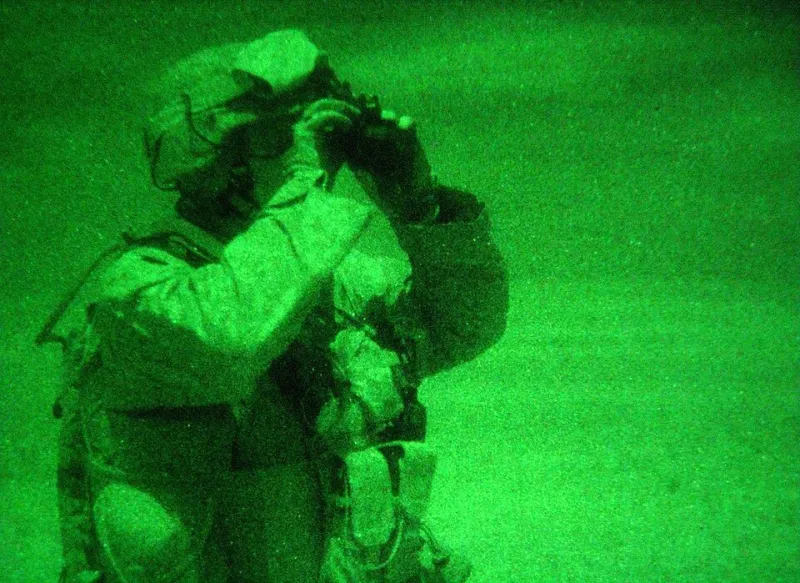
Photo: Sgt. Brian Tuthill, Public domain, via Wikimedia Commons
Thermal monoculars used to be cop-only gear. Then they were $6,000 cop-only gear. Now they're on the shelf at your local farm supply store for under $500, and every box promises the same thing: "detection range up to 1,200 yards."
That number is doing a lot of heavy lifting.
I spent $2,500 of OP Review's money on five budget-to-midrange thermal monoculars — units from AGM, FLIR, Pulsar, HikMicro, and one brand you've probably never heard of — and took them out for ten nights of actual work: walking fence lines, hunting down why the garage wall is cold, and figuring out what's rustling in the timber behind the house. Here's what the spec sheets won't tell you.
The Contenders
- AGM Taipan TM19-384 — $489, 384x288 sensor, the budget pick everyone on the forums recommends
- FLIR LS-XR — $899, the "name brand" option at the big-box stores
- Pulsar Axion XG30 — $1,299, the step-up unit with a 640 sensor
- HikMicro Lynx Pro LH19 — $549, the one your hunting buddy swears by
- A certain no-name Amazon unit — $299, included because somebody has to test it so you don't have to
Detection Range: The Biggest Lie in Optics
Every manufacturer quotes "detection range," which — legally — just means "the distance at which a human-shaped heat blob is technically one pixel." Nobody is identifying a raccoon at 1,100 yards. Nobody is identifying anything at 1,100 yards.
What matters is identification range: the distance where you can tell deer from cattle from your neighbor's lost dog. In my testing:
- Pulsar Axion XG30: solid deer ID at 250-300 yards
- HikMicro Lynx Pro: confident ID at 150-200 yards
- AGM Taipan: about 120-150 yards before everything becomes a smudge
- FLIR LS-XR: 100-130 yards, which stung at this price
- The no-name: roughly "across the road"
If you're scanning a 40-acre property, the 640-sensor Pulsar is a different tool entirely. If you're checking a two-acre homestead, the AGM does 90% of the job for 40% of the money.
Battery Claims vs. the 20°F Reality
Spec sheets love to quote battery life at room temperature. Thermals drink power when it's cold — the sensor draws more, and lithium cells sag.
The HikMicro claimed 7.5 hours. On a 22°F January night in Wisconsin, it delivered about 4.5. The AGM's quoted 7 hours became closer to 4. The Pulsar, to its credit, ran 5 of its claimed 6.5. Only the no-name exceeded expectations — but only because its expectations were already dismal.
Practical rule: divide every quoted runtime by 1.5 if you're operating below freezing. And carry a USB-C power bank. Four of the five units charge or run off external power, which turns "battery life" from a spec into a non-issue.
The Homeowner Use Case Nobody Talks About
Half the people buying these aren't hunters — they're homeowners and small-property folks. Finding where the raccoon is getting into the barn. Locating a hot bearing on a tractor. Spotting exactly which window seal is bleeding heat before winter.
For this, you don't need 640 resolution or 300-yard ID. You need a wide field of view and a decent UI, and here the AGM Taipan quietly embarrasses everything. Its 25Hz refresh is smooth enough to walk with, the menu is learnable in five minutes, and at $489 it's the unit I actually grabbed on my way out the door by night six.
The Verdict
Best overall for most people: AGM Taipan TM19-384. Eighty percent of the flagship experience, one-fifth of the flagship price.
If budget allows: Pulsar Axion XG30. The 640 sensor and app connectivity are genuinely worth it if you're scanning big acreage.
Skip: The FLIR LS-XR. You're paying for the logo. And the $299 no-name — don't. Just don't.
Ten nights in, the biggest thing I learned wasn't about any single unit. It's that thermal is a tool for finding, not identifying. Once you internalize that, you stop chasing detection-range numbers and start buying the right glass for the distance you actually stand at.
For most of us, that distance is a lot shorter than the box says.