Estate Sale Optics: $500, Eleven Dead Photographers' Collections, and a Spreadsheet That Doesn't Lie
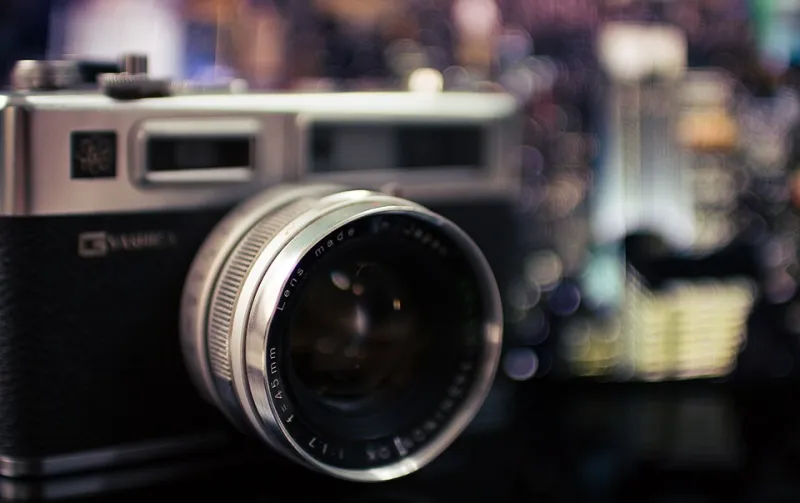
Photo: Nirzar Pangarkar nirzar, CC0, via Wikimedia Commons
Estate sales are where camera gear goes to be mispriced. Sometimes wildly in your favor. Sometimes the opposite.
Over five weekends, I hit eleven sales across three states with $500 cash, a flashlight, a loupe, and one rule I refused to break: I'd only buy gear a working photographer would actually put to use in 2025. No shelf queens. No "collectible" boxes of mystery cables. If it couldn't earn its keep, it stayed on the folding table.
Here's how the money went, what turned out to be garbage, and what I'd tell you before you walk into your first garage full of somebody's late father's camera bag.
The Ground Rules
Every purchase got logged. Every item got tested within 48 hours — batteries in, lens on a body, shutter fired. At the end, I listed the keepers at realistic used-market prices (think KEH and eBay sold listings, not asking prices) to see where I actually landed.
The $500 budget broke down like this: $312 on camera bodies and lenses, $118 on optics — binoculars, a spotting scope, one rangefinder — and $70 on bags, filters, and miscellany that mostly regretted.
What the Heirs Think Things Are Worth
Let's get the biggest lesson out of the way: the price tag at an estate sale reflects the family's grief, not the market.
The worst offender was a Canon EOS Rebel film body with a plastic 35-80mm kit lens, tagged at $85 because "it was his favorite camera." I've got news — that lens has a mount made of feel and hope, and the body is worth maybe $30 on its best day. I passed. A sale in Cincinnati had a beat-up T2i with the same kit lens priced at $200 "because it's digital." Digital, yes. Worth a fifth of that, also yes.
The flip side: most heirs have no idea what a good lens looks like. The single best buy of the whole run was a Nikon 105mm f/2.5 AI — the lens, basically, from The Graduate and half of Steve McCurry's portfolio — sitting in a Tupperware bin marked "camera stuff, $40 each." It was clean, smooth, and clear. It sold within a week of listing for $310.
The Gold
- Nikon 105mm f/2.5 AI — $40 in, ~$310 out. The whole trip's profit margin in one Tupperware.
- Pentax Super Takumar 50mm f/1.4 (8-element) — $25. Slight haze I cleaned with a proper strip-down. Sold for $140.
- Nikon 7x35 binoculars, likely 1970s EII-adjacent — $30. Collimation checked with a star test in the driveway: dead on. Kept. These now live in my truck.
- Bogen/Manfrotto 3021 tripod — $20. Heavy as sin, indestructible, and someone always needs one. $75 out.
The Junk
- A "vintage lens lot" of five fungus-covered third-party zooms at $15 each. Fungus spreads. Pass on all of it.
- Two point-and-shoots from the late '90s, tagged at $30 apiece because "film is back." Film is back; these cameras never left.
- A spotting scope with a cracked objective — visible the second I put my phone light on it. Tagged $120. It was $10 of parts.
The Five-Minute Inspection
Bring a phone flashlight and a lens loupe. In order:
- Shine light through every lens at an angle. You're looking for fungus (spidery filaments), haze (foggy film), and cleaning marks (tiny swirl scratches on the front element).
- Work the focus and aperture rings through their full travel. Gritty focus rings mean dried lubricant; oily aperture blades mean the lube migrated. Both are fixable, neither should be priced as "fine."
- Check the shutter on film bodies at every speed you can. Sticky slow speeds are common and cheap-ish to fix — use it as leverage, not a dealbreaker.
- Look through binoculars at a distant sign. If the two halves don't merge into one image, collimation is off and it's a paperweight unless you enjoy alignment jigs.
- Open the film door. Light seals crumbling is normal. Shutter curtains with pinholes are not.
The Negotiation Playbook
Estate sale negotiation is different from a flea market. You're talking to someone having the worst month of their life, often an adult child who just wants the garage empty.
- Bundle, don't browbeat. "I'll take the Nikon and the tripod for $50 total" works. "This is only worth $40" does not.
- Point out defects gently, as information, not accusation. "The haze in this one would cost more to fix than it's worth — would you do $15?" lands fine.
- Go on day two. Most estate sales discount 25–50% on the final day. The trade-off is picked-over inventory, but the 105mm proved the gems survive because nobody looked.
- Carry cash in small bills. A $20 in hand ends conversations.
- Know one number cold: what things actually sell for. Check eBay sold listings on your phone in the driveway. The person across the table almost never has.
The Final Tally
$500 out. Resale value on everything moved or kept, at honest used-market prices: $1,090. Net after the ~$40 in gas and a truly regrettable gas-station corn dog: roughly $550 in the green, plus a very good set of 7x35s I have no intention of selling.
The Verdict
Estate sales are the last underpriced corner of used camera gear in America — but only if you can test on the spot and walk away from the grief-priced table. Bring a flashlight, know your sold prices, and never buy the kit lens. The real inventory isn't the gear. It's the heirs' complete disinterest in what a 105mm f/2.5 is. That disinterest paid for this entire experiment and then some.