Cash on the Counter: What Your Camera Gear Is Really Worth When You Need Money by Friday
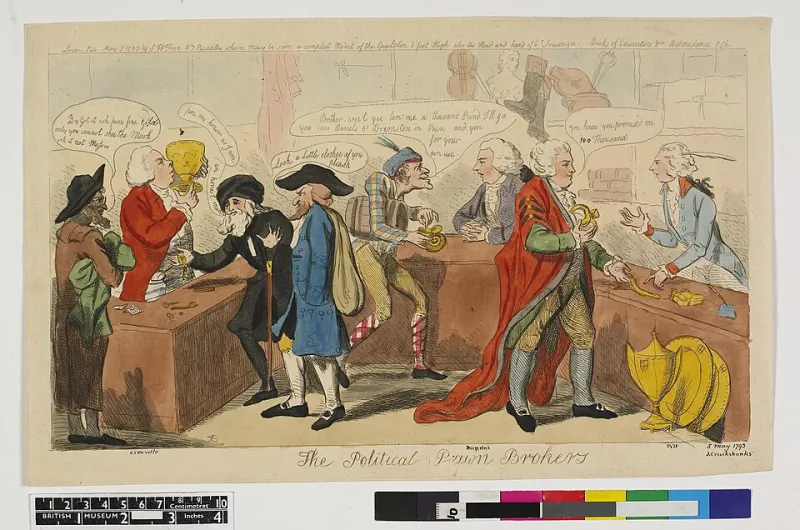
Photo: Print made by: Isaac Cruikshank Published by: S W Fores, Public domain, via Wikimedia Commons
Everyone loves to say camera gear 'holds its value.' Nobody saying that has ever needed four hundred bucks by Friday.
So I did something slightly embarrassing and extremely useful: I walked into twelve pawn shops across five cities — Detroit, Nashville, Boise, Phoenix, and a Vegas suburb — and tried to get quotes on the same three items everywhere I went. A Canon RF 50mm f/1.8, a used Fujifilm X-T4, and a pair of mid-tier Vortex binoculars. Same gear, same condition, five different economic backdrops.
What I learned should change how you think about buying gear.
The Ground Rules
Every shop got the same pitch: I'm looking to sell, not pawn, and I want a number today. I noted the opening offer, the counteroffer after mild negotiation, and how long the whole thing took. Anything under two minutes of deliberation means the counter person knew exactly what they were looking at — which matters more than you'd think.
The Brand Hierarchy Nobody Talks About
Here's the blunt truth, ranked by how fast gear turned into an actual number:
1. Canon and Nikon DSLR-era bodies and lenses. Instant recognition. Every shop had a checklist for these. Quotes ranged from 30–45% of used market value, and the process took minutes. The counter people didn't need to look anything up — they've moved a thousand 5D Marks and 50mm f/1.8s.
2. Vortex and Leupold optics. The binoculars were the surprise hit. In Boise and Phoenix especially, optics are a known commodity — hunting culture means staff can spot fakes, check collimation, and price on the spot. Vortex's transferable warranty came up unprompted at three counters. That's real resale juice.
3. Fujifilm and Sony mirrorless. Recognizable, but slower. Two shops had to look up the X-T4. Quotes landed around 35–50% of used market, which is actually better than Canon percentage-wise — the staff just weren't as quick about it.
4. Everything else. Sigma art lenses, vintage glass, anything obscure. Lowball city, or a polite 'not really our thing.' One shop in Detroit wouldn't quote my 1970s Minolta at all.
Location Changes the Math — A Lot
The same Fujifilm body got $340 in the Vegas suburb and $475 in Boise. Why? Supply and demand, plain and simple. Cities flooded with tourist-adjacent resale traffic have more inventory and less urgency. Markets where people hunt, hike, and shoot local sports hold gear value harder.
If you're buying with resale in mind — and you should at least think about it — buy what sells easily in your region, not just what reviews well nationally.
The Discount Is the Real Number
Across all twelve counters, here's what 'times get tight' actually costs you:
- Canon RF 50mm f/1.8 ($199 new): $60–85 offered. That's a 60–70% haircut.
- Fujifilm X-T4 (used market ~$1,300): $340–475. A 63–74% discount.
- Vortex Diamondback binoculars (~$250 used): $100–140. Consistently the best percentage.
Compare that to selling on your own: a Facebook Marketplace or MPB sale typically nets 70–85% of market value, but takes a week to a month and involves strangers at your door. The pawn counter is a 60–70% fee for instant liquidity. That's not a scam — it's a price tag on speed.
What This Means When You're Buying
Flip the whole exercise around and it becomes a buying guide:
-
Popular beats precious. The boring Canon lens resold in 90 seconds. The quirky vintage glass got laughed at. If there's any chance you'll flip your gear, buy boring.
-
Warranty-transferable optics are currency. Vortex's no-fault warranty made my binoculars worth quoting instantly. Brands without that? The counter people hesitated.
-
Cheap gear is a money pit at both ends. Losing 65% of $200 stings less in dollars but hurts more in percentage terms than losing 60% of $1,300. Budget glass is disposable; mid-tier glass is liquid.
-
'Investment' is a word for people who haven't visited a counter. Nothing I carried into twelve shops appreciated. The best case was losing about half. Gear is a rental you pay for upfront.
The Verdict
If you need cash fast, the pawn counter works — but budget for losing two-thirds of your gear's value. If you're shopping instead of selling, buy the gear that counters recognize on sight: mainstream Canon and Nikon, warranty-backed optics, current-generation mirrorless from the big three.
And that vintage oddity you're eyeing? Buy it because you'll love it. Because when Friday comes, nobody at the counter will.